

(You can read Part 1 here)
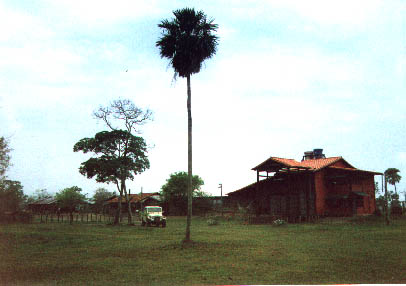
The 100Km. journey to Cutal is by dirt road, in the dry season often dried into iron hard ruts. If it should rain it is swiftly converted to mud. However there is lots of wildlife to see on this level plain which is very similar to the Pantanal of Brazil.
At the Cutal parrot life abounds, large macaws fly in pairs from tree to tree (Aras ararauna, chloroptera, auricollis and severa) whilst a host of amazons, conures and parakeets chatter and quarrel about the house. Early morning is the best time to see them. One also has chance to participate in traditional cowboy activities if so inclined.
On the second day we set off to see the blue throated macaw. No-one knows how many of them there are but certainly they number only in the hundreds. It is similar to the blue and gold macaw but it lacks the green patch on its head, it’s eye stripes are blue and of course it has the blue throat. It is also slightly smaller and much quieter. Its call is less hoarse, less frequent and slightly higher pitched than the blue and gold. It seems to me that the colours are more intense than those of the blue and gold. Blue and gold macaws are very common around here and it mingles freely with them.
 We bumped our way across the coarse grassland in our 4×4 on a level plain that extended from horizon to horizon, big country indeed! The heat was intense. The palm island we visited was about 20Ha in size, we parked some distance away and crept into the edge of the trees at a place where Lyliam had previously seen the B.T.M. We sat there quietly and soon we saw two pairs and then later another. They were quite wary and we had to stay very still in spite of the heat, humidity and biting insects.
As darkness fell the hen bird clambered down to their nest hole which was previously unknown to us. Lyliam was entranced. The cock bird remained high in the totai palm. In the last rays of the sunset his golden breast feathers glowed like fire, his turquoise gorgette was incandescent.
From his lofty vantage point he could see enemies coming from afar. But he could not see the black hole of oblivion and its dark cohorts though they stood close by. There was greed that always wanted more. There was indifference that cared only for itself. There was possession that could not see but it had to have. And there was the darkest of all, vanity (called status by some) that always needed yet brighter and rarer jewels to surround itself with. And he was the brightest jewel of them all. His enemies were without pity or remorse. His friends were few and far apart and his allies were already corrupted by the dark cohorts. Macaws cannot weep but I could have wept for him.
The next day we set off on the dusty road back to Trinidad. Before we had got far, out of the general murk in front of us loomed the most gigantic Cumulo Nimbus cloud (thunder cloud) I have ever seen. It was so huge that it’s extent could not be gauged from the ground. Our road arrowed straight under it. The air was hot and humid, a gusty wind was at our backs, wild dust devils danced around us. As we drew near rain could be seen falling both on our left and right, ahead seemed to be clear. It seemed that we might pass right under it unscathed.
 As we passed under the centre of the cloud the wind died, the air was now rising vertically into the black abyss that lay a few hundred feet over our heads. (I am a glider pilot, if I had been in the air such a sight would have filled me with terror, I would not have had long to live.) The black hole was surrounded by rotor clouds that came and went as the tortured air was sucked into this awful vortex. Amazingly we passed beneath this daunting manifestation of nature’s power without incident. As we emerged from the other side, the wind once more picked up but now in our faces. The road was wet, a thin film of sludge covered the iron hard mud beneath. It was almost as bad as wet ice, for the remainder of the journey we skated from one side of the road to the other. At one point it seemed we were not going to make it, if there had been even the slightest slope we would have been defeated.
Blue throated macaw facts:
(a) In the past many have been trapped and exported to North America, long after it was legal to do so. This is less so at the moment due to the fact that they are now extremely hard to find. No-one knows how many there are in the wild but certainly less than a thousand. Prices have fallen as they are apparently fairly easy to breed in captivity. However a known trapper has been recently in the vicinity asking questions about blue throated macaw.
(b) The grass surrounding the palm islands where they live and a breed is annually burned. Should the fire spread into an island (and it could easily) this would be a catastrophe.
(c) Habitat destruction. Every year the islands become smaller due to burning and browsing by cattle.
 (d) A well known American Eco-tourism firm is proposing to fly well heeled twitchers into the Estancia San Miguel, where the largest numbers of blue throated macaws are to be found. Parrots often confuse aircraft with aerial predators. This will surely cause unnecessary disturbance, particularly as it is proposed to continue this activity into the nesting (wet) season when all the roads are impassable. This possibility is viewed with alarm by local conservationists. (Personally I wouldn’t set foot in a local light aircraft. Essential maintenance work is not carried out and there are aerial cowboys in Bolivia!)
(e) Lyliam Gonzales and “Armonia” are conducting an education programme of local people and are trying to get the local land owners co-operation to preserve the palm island habitat.
(f) Very little research has been done into the BTM and how it interacts with the far for numerous Ara Ararauna with which it mingles freely. By the most amazing coincidence, at the time we were there Pepé Rojas, an up and coming young Peruvian ecologist arrived. He is hoping to make a study of the BTM. We first met Pepé at the Tambopata Research Centre when he was studying for his degree. I have to say he seems to be outstandingly qualified for the job. He speaks excellent English and has a very pleasant and easy going nature.
{Stay tuned for Part 3, to be published in the next days.}






Congratulations Harold Armitage on on a really beautiful piece of writing. I look forward very much to part 3.
Thanks!