
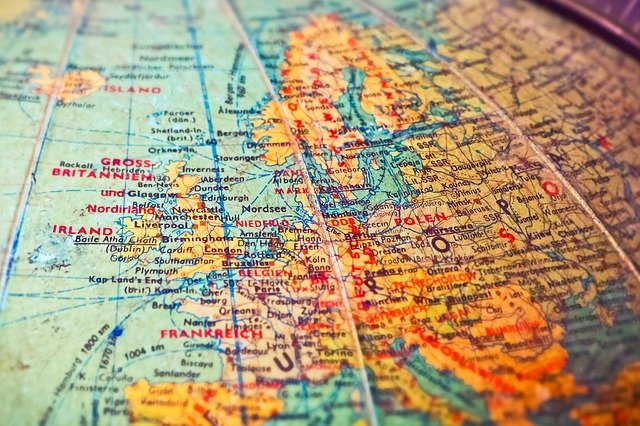
I wonder whether any other country has the problem we have here in – and that is the problem. What is the name of our country? Do we live in Britain, Great Britain, the United Kingdom, or the British Isles? Or come to that, do we now just live in England, Scotland, Wales or Northern Ireland?
Let’s start off with ‘Britain’. Britain, as we know, is a largish island, off the northwest coast of Europe. Its name is derived from Britannia, the term used when large parts of the island were under occupation by the Roman Empire from CE 43 until CE 410. Since 927, when seven small Anglo-Saxon kingdoms were merged by King Athelstan of Wessex to become one kingdom, there have been three countries in Britain: England, Scotland and Wales.
And then there is ‘Great Britain’, a name for which there are a couple of explanations. No, the ‘Great’ portion of it does not mean ‘Wonderful or Marvellous’, although we know it is just that. ‘Great’ can just point to the fact that Britain is the largest of the islands in this area or to the fact that just across the English Channel is a small area of France named ‘Britany’ – the ‘y’ being a diminutive. This came into being when the Anglo-Saxons and other Germanic tribes invaded Britain after the Romans had left, pushing the Celtic tribes further and further west until they moved to the nearest place overseas, on the coast of the newly-named France. These days the name ‘Great Britain’ is often linked with ‘The United Kingdom’, or more completely ‘the United Kingdom of Great Britain and Northern Ireland’. But how did it get there?
Wales, for most of its history has been ‘annexed and united’ to the English Crown.
Scotland, on the other hand, was an independent country for most of its history – even the Romans found it impossible to conquer! It was only when Elizabeth I of England died in 1603, that her cousin, King James IV of Scotland also became King James I of England and so the Crowns were linked, and it wasn’t until 1707 that full political union took place in the form of ‘The Kingdom of Great Britain’.
Ireland had been gradually brought under English control between 1541 and 1691 and then in 1801 an Act of Union was signed to create ‘The United Kingdom of Great Britain and Ireland’. In 1922 Ireland was partitioned into the Irish Free State in the south while six of the nine counties of the province of Ulster remained within the UK giving the Irish Free State the status of a Dominion. However this came to an end in 1937 when it became fully independent and took the name of Ireland or Eire so that for Britain the collective name then became ‘The United Kingdom of Great Britain and Northern Ireland’.
Since then the term ‘The British Isles’, which once encompassed both Britain and Ireland, has become a somewhat controversial term but can’t be completely ruled out since Great Britain is surrounded by anything up to 40,000 little islands, or according to some sources, even more. So ‘The British Isles’ remains a respectable name.
But what about the other ‘Isles’ around the United Kingdom? While most belong to England, after the Roman occupation, the Isle of Anglesey which lies to the northwest of Wales formed part of that country. The Northern Isles of Orkney and Shetland together with the Inner and Outer Hebrides were originally occupied by Vikings and Scandinavians and only came under the jurisdiction of Scotland in the late 14th century.
The Isle of Man, an island off the northwest coast of England, has a similar history. Following Viking invasions which began in about 800, the Isle was a dependency of Norway but in 1266 it was sold to Scotland and later came under English control. Where it differs from the Welsh and Scottish Islands is that the Isle of Man is not part of the United Kingdom and the Queen is officially ‘Lord Protector’ of the Isle and is formally referred to on the Isle as ‘The Queen, Lord of Man’. The Isle is a self-governing British Crown Dependency with its own parliament, government and laws. It still has a Scandinavian system of government and its House of Keys is regarded as one of the most ancient legislative assemblies in the world.
In the English Channel, close to the French mainland are the Channel Islands which consist of two ‘Bailiwicks’, that of Jersey and that of Guernsey which is comprised of the Islands of Guernsey, Alderney, Sark and Herm. Once again, the Islands are not part of the United Kingdom and are Crown Dependencies and self-governing possessions of the British Crown, but as with the Isle of Man, the United Kingdom is responsible for the defence and international relations of the Islands. These small islands, which are so close to the French coast as to seem more French than English, were part of the Duchy of Normandy and among the possessions that William the Conqueror brought with him when he became King of England in 1066. Which is partly the reason that the loyal toast on the islands is to ‘The Duke of Normandy, our Queen’.
So, do we live in the United Kingdom of Great Britain and Northern Ireland, in Britain or in the British Isles? It may be that within the next few years, with Scotland pressing for independence, with Wales muttering about the same and with the ever-present possibility that Ireland might once again become one island, we shall just be living in our individual countries of Eire, England, Scotland, Wales, the Isle of Man, the Channel Islands – or even a newly independent Cornwall.





Thank you Sonya. You’ve filled in bits of history I did not know.
French customs officials chuckling about how post brexit we can no longer call ourselves U.K. because of ‘losing’ N.I. rather raised this whole question didn’t it.
It struck me that going back to G.B. GREAT Britain, maybe was no longer appropriate.
Oh, surely James 1 of England was James V1 of Scotland, not 1V.
Have a watch of this:
“The Mary Rose; a new attempt to rewrite English history”
https://youtu.be/Rwe560kBrik
The British Navy was in the habit of rounding up/kidnapping anybody they could get hold of to crew their ships back then
There were Frenchmen in the British fleet fighting the French at Trafalgar.