
Written by Bob Lomas
By the time I returned home at the end of WW II my wife, my mother and Mr. Ballard who had formerly been my father’s cowman and had been called out of retirement for the duration, had had enough of running our small farm. We only milked twelve Shorthorn cows, but it was all by hand in those days; one of the first things I put right on my return. So it was back to milking, and what a delightful contrast it was from the mosquito infested swamps of Burma!
Just two months after my return the winter set in, and it was harsh. Following my several years in the tropics I even thought of emigrating to Australia, but to an English dairy farmer there is only one place in the world to find a proper meadow, and the farm had been in my family for generations. The winter eventually passed, giving way to a most beautiful Spring, followed by a blissful Summer. I was home, and although shortages persisted, all was well, in my world at least.
One particularly lovely Summer afternoon I walked down to the millpond meadow to get the cows in for milking. The sky was blue with puffy white clouds. It was no doubt hot for the locals, the lane was dusty, and along its edges dandelion and mayweed flowers smiled up at me as I passed. The cows were waiting by the gate as usual. I opened the gate for them to make their way up to the dairy, there was no traffic to worry about in those days. Before following them I cast my eye across the meadow towards the pond. The grass was greener than green, over which was a yellow hue of buttercups. I then noticed something white laying on the grass just in front of the bulrushes at the edge of the pond. I very nearly disregarded it but my curiosity got the better of me and I walked over to see what it was.
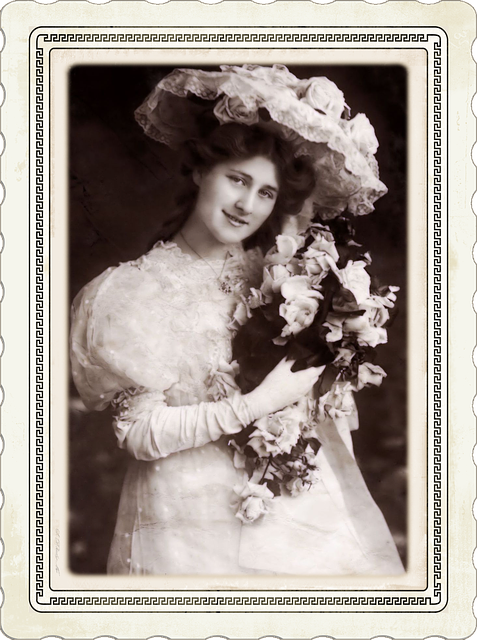
It turned out to be a beautiful lady’s hat made from shiny cream straw. It looked brand new. There was a splendid white satin ribbon and a white ostrich feather, like a plume. It seemed like a lady’s wedding hat, but very old fashioned. It reminded me of a hat worn by my great aunt Minerva in a large sepia photograph we had at home. I was amazed that the cows hadn’t eaten it. But where could it have come from? I walked right round the pond but could find no one. As I walked back to the dairy I decided that after milking I would drop the hat off at the Police House where all such finds usually end up.
My route took me past the farm house, so I looked in the kitchen door and called out to my wife to show her the precious hat. I then remembered that she had gone on the bus to visit her sister in the next village. I left the hat on the kitchen table and proceeded to the dairy. After milking I drove the cows back to the millpond meadow.
I was just shutting the gate when Roger, an old school chum, came hobbling along. He had suffered badly in the North African campaign and could no longer fell trees. To fill his time he had become something of a local historian. He was clutching a book which he seemed very pleased with, so I asked him what it was about. Roger told me it was a book about the village he had never seen before, the library had found it and put it by for him. He told me he had only read the first chapter, and very sad it was by all accounts.
It seems that just after the death of Queen Victoria, a young couple from two wealthy London families eloped, they came to the village and took a room at the White Horse Hotel. Just after arriving the girl went up to their room and the young man crossed the street to the grocer’s shop for some tobacco. Whilst crossing the street an unattended horse took off complete with its carriage, the young man was struck down and killed instantly. A small crowd gathered but no one recognised him. But then a carriage drew up, and out stepped a gentleman who did recognise the young man. The gentleman instructed his coachmen to put the body in his carriage and he took it straight back to London.
The young lady knew nothing of this, and became very anxious when her lover failed to return. She searched and searched and asked everyone if they had seen him. But in those days country people were suspicious of all strangers, and would not speak to her.
After a week the young lady could no longer pay for her board. She had to believe that her lover had deserted her. She could not return home, there was no where for her to go. She was ruined. A farmer found her body in the reeds at the edge of the millpond, having spotted her hat laying on the grass.
The hat! The HAT!
Roger must have thought me quite mad as I took off and ran home as fast as I could go. My wife had returned and was watering some flowers in the garden. I rushed past her and into the kitchen. The hat was gone!
Rushing back outside I called to my wife, “The hat, where is the hat?”
She asked me if I was referring to that dirty rotten old thing I had left on the kitchen table.
“Yes, yes” I answered, “what have you done with it?”
“I threw it on the corner of the dunghill” she answered.
I ran to the dunghill.
Just where she said it was, I could see a few wisps of rotten straw, a small fragment of dirty ribbon and a short length of thin rusty wire …



My first reaction was – one of the lucky ones – he did return. And what an ideal life to come home to.
I love these ghost stories from Bob Lomas………
Romantic ghosts making one tingle with warmth and yet shiver with the coldness of reality
Well done Bob Lomas who writes so beautifully. Thank you.
Above all perhaps our gratitude to our clever,insightful, wise and hard working Viv who brings the light of truth to shine in our lives.
Roger WM
Briefings for Freedom
The first paragraph had me hooked. Later the goose bumps. Another lovely story that conjured up a world so far away. Warm summers and flannels and the chalk Downs. P’tang, Yang, Kipperbang and all that. We need a time machine!
It`s not particularly the spookiness that grips me regarding these stories, but it is for want of a better word WW2 Nostalgia that it engenders.
As an evacuee living in a former farm cottage and with free access to all aspects of daily mixed farm life, I remember the herd of cows, what an assortment – not like your modern integrated single breed of Fresians, Charolais or Jerseys, but an assortment of colours, shapes, bag sizes, some upright horns, some crumpled horns, some with “hipes” often quite long running scars where they have caught each other with those horns.
The milking sheds, `our farm` did milk with machines, but often hand milking was required to start new ladies off and often there was a kick and an upturned bucket for his pains.
There was the dairy with the milk cooler over which the milk descended in a series of ripples and then there was the churns.
There was even a Christmas party for the farm children and evacuees, we even had real ice cream. during the war.
and there was the can of milk I collected from the farm every day and hung on the handlebars of my bicycle and carefully carried along the farm track to our cottage 5 fields from the road.
Luckily we didn`t return to city life until 1947, we were bombed out and accommodation just wasn`t available for an early return.
So please keep the stories coming they are great. Pity the hat got couped!
Nice one Bob. – Keep them coming as they are just the right length, and entertaining !
Excellent spooky story. Are we having a competition?
We could do one – get the ball rolling by writing one and handing it in. That means you and all other readers/comment posters!