
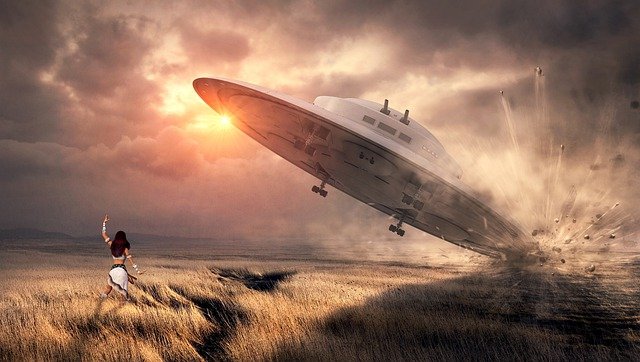
At the end of December 2019, former President Trump officially launched a new US military service focused on warfare in space — the US Space Force. ‘Space,’ he said, speaking at an army base near Washington, ‘Is the world’s newest war-fighting domain.’ This followed the Air Force Space Command which was established in 1982 to detect missile launches and monitor military movements around the world and more recently to check on Russia and China as they began to launch more of their own space assets. But there could be other reasons for upgrading a Space Command into a Space Force.
In December 2020, as part of an Omni Bill on Covid Relief, passed by both houses of Congress and signed by President Trump, the Director of National Intelligence was called on to put together a report on Unknown Aerial Phenomena (UAP), the current term for UFOs, within 180 days of the signing of the Intelligence Authorisation Act. Because this Act was signed by the then President of the United States, the report was therefore enacted into law and should be made public on 1st June 2021.
This indicates that in spite of denials over the last decades, there does exist an Unidentified Aerial Phenomenon Task Force (UAPTF) operating within the Office of Naval Intelligence (ONI). And many other nations operate in the same way, denying they have any interest in these UAPs which have been sighted not just across the USA but over all continents of the world since 1947. World-wide reports of such unknowns have existed over many hundreds and, in fact, thousands of years, but only since the mid-20th century have so many sightings taken place and been seen by so many people.
The first sighting which made headlines was that by Kenneth Arnold, a private pilot, who on 24th June 1947, saw nine silver discs pass Mount Rainier in Washington State, USA, at an estimated speed of 1,200 mph, far higher than any known aircraft could reach at that time. This first report must have caused concern and hesitation in government circles but a few weeks later, on 9th July when a Flying Saucer, as it was first called, was reported to have crashed in Roswell, New Mexico, the US government was ready to put a blanket ban on such information reaching the public. The remains of the craft were quickly taken away by the military, a report of the crash in the newspapers was reversed the following day, saying that it was simply a weather balloon, and all those in Roswell who had seen or heard about the crash were threatened with severe reprisals if they mentioned it to others.
And this became the rule around the world as more sightings of what were later termed UFOs were reported. In addition, such reports began to be ridiculed. What had been seen, the authorities said, was merely a flight of birds, swamp gas, natural phenomena or often just a hoax and yes, in many cases the sightings could be explained. Nevertheless, it was usually said about anyone who reported them, that they were imagining things. Perhaps, it was said, such people were not suitable to hold responsible positions at work. This became an earlier form of ‘deplatforming’ so that even commercial or USAF pilots — and later, US astronauts — hesitated to report any UFOs for fear of losing their jobs.
At the time, the US and other governments had good reason for their clampdown.
Firstly, these lights or crafts seemed to have no wings or normal propulsion system; they could immediately stop and start, could hover, turn right angles and travel at speeds far above those reached by other known earthly planes. And so, it seemed, were under intelligent control. But if they came not from Earth but from ‘somewhere else’, how could the government inform their people that yes, UFOs existed but they didn’t know what they were, where they came from and if they did have any aggressive intent, there was nothing their government could do about them.
Secondly, if the government could quietly continue to collect debris from other UFO crashes (and as time went on, there were more) then they might be able to reverse engineer the craft or at least their materials, and so take a world lead.
Thirdly, there was the fear of the unknown. How would the sudden knowledge that there were indeed other inhabited worlds affect the world’s populations and especially the religions?
Another fact which troubled the US and other governments was the question of why these UFOs were coming now? Was it because of the West’s sudden spurt in technology over the past century and the two devastating wars this technology had caused? Was it that it may not be long before the people of Earth were heading out into space – as indeed happened in 1957 when the USSR launched Sputnik, the Earth’s first artificial satellite? Governments found it worrying that UFOs were often seen over Air Force bases. In 1956 at RAF Lakenheath in Suffolk, one of several in the UK used by the US Air Force to store nuclear weapons during the Cold War, had to launch waves of aircraft to intercept UFOs which had penetrated the UK’s radar shield. In 1967 at the US air base in Montana, ten Intercontinental Ballistic Missiles (IBCs) became inoperative as a UFO flew over the base, and nor was this the only time: on several occasions after UFOs were sighted nearby, these weapons shut down and had to be re-started.
Over the decades, in spite of censorship and ridicule, the reports of unknown lights or flying craft increased. They were seen in all shapes and sizes, not only singly but in fleets. And although rarely reported in the media — and then only as jokes — this provoked demands from the people for an explanation so that in response the US government eventually set up projects, such as Project Blue Book, to look into the matter. These were basically designed to find that UFO sightings could mainly be explained away and those which were inexplicable could be classed as harmless.
However, not all of the military and scientific members of the Project were in agreement with this plan. Astrophysicist Professor J. Allen Hynek worked with Project Blue Book for 20 years but eventually became convinced that some UFOs were genuine and set up his own independent Center for UFO Studies.
In the UK a department within the Ministry of Defence was set up at the request of Winston Churchill, to investigate cases of reported UFOs in order to see whether they had any defence significance. Nick Pope, a long-term civil servant, held what was commonly known as the ‘UFO desk’, from 1991 to 1994 but this desk was apparently closed in 2009, in spite of a surge in reported sightings, because it was said to be serving ‘no defence purpose’. Although originally a sceptic, Nick Pope finally left the Civil Service in 2006 and, as in the case of Prof. Hynek, carried on investigations on his own behalf.
But sightings and knowledge of what were later termed UAPs increased and as the Millennium approached, gradually, very gradually, the censorship was lifted, and the ridicule softened. Beginning in 2008, the projects and the desks were closed and their staff allowed to join an international body called The Disclosure Project which had been formed in 2001.
[Stay tuned tomorrow for Part 2]





Riveting stuff Sonya. I await part two with great interest and anticipation!
Fascinating I look forward to tomorrow.
Thank you for providing such a good overview of something which, I have to admit, I’ve never taken much notice of.