
[… continued from Part 1 which you can read here]
On Sunday we wandered through the town Samaipata which is desperately poor. Mains water was only just being installed. Interestingly the pipes had been laid in the trenches, connected and then left. I think the locals hoped that the trenches would spontaneously disappear. It did seem to be working. Telephones and electricity had only arrived in the last few years. There is only about 50 yards of paved road in Pampagrande. The land around is medium altitude (3000ft) semi desert, the natural vegetation being thorny scrub and trees interspersed with cactus, giant and small. Rain, when it comes, arrives in intense storms. The soils are very poor, light and sandy. Nevertheless the locals cultivate it, maize, ground nuts and melons being popular.
On Monday we accompanied Hermano Andre on a long jaunt with the 4×4 into the mountains, along precipitous dirt roads, in order to visit the tiny pueblo of Santa Rosa. At one point we climbed to almost six thousand feet although the mighty peaks still towered about us. We covered a wide range of altitudes and habitats and saw many parakeets, conures and severe macaws in the wooded lower slopes of the mountains. There were many stops along the way as Hermano Andre chatted to his flock. They were for the most part desperately poor farmers living in tiny adobe houses with earth floors.

Road to Santa Rosa
At Santa Rosa we were fed and watered by the brother’s parishioners. There are no services here of any description. None of the streets are paved and we saw more donkeys than trucks. No car could make it to Santa Rosa I think. Communication with the outside world is by means of one solar powered radio. Many of the locals keep parrots, Ara Severa and Amazona Festiva being the most popular as they are very common. The wings are generally clipped and they are left to wander about outside in the bushes. Most are taught a few words of Spanish.
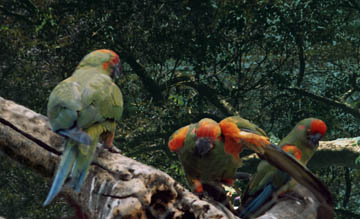
Hermano Andre had put out the word and a couple of days later we were able to visit a site where the RFM (Red Fronted Macaw) had been seen feeding. This was only a few miles from Pampagrande, and we observed a flock of seventeen noisily feeding on the fruit of the “Tatco” tree (Jacaranda Mimosifolia). They are quite hard to spot due to the predominantly green colour, only being given away by the racket! It didn’t take them long to spy us and when they did they were off, surprisingly colourful as the underside of their wings is a bright orange/yellow pattern.
SOME RED FRONTED MACAW FACTS
(a) Once again no-one knows for sure how many Ara Rubrogenys there are left in the wild but certainly less than two thousand. Many were trapped in the past and exported mainly to North America. This has probably ceased now. The locals don’t care for them as pets as they won’t talk. Local ornithologist Robin Clark conducted the last scientific survey of them eight years ago. His recommendations to ensure their survival were totally ignored and the situation has since worsened considerably.
(b) The natural habitat of this species is being cleared for agriculture. This leads to them turning their attentions to the farmers’ maize and groundnuts which in turn can lead to them being shot. Hermano Andre is trying to educate the local population in this respect. He has suggested that farmers could be compensated for the damage if there was money. (Now there’s a project for someone!)
(c) The RFM nests in holes in cliffs. Many of the nesting places used in the past are now abandoned. The holes are usually too high to reach, so the method of capture was to spread monofilm nets over bait. Landing macaws got their feet tangled in the nets.
(d) The RFM have a daily migration pattern which varies with time of year and their food source.
DIY TRAVEL TO SEE THE RED FRONTED MACAW
There’s no doubt that this is a tougher one as this is an area not frequented by tourists and except for Olav of “Roadrunner” no-one speaks English. Some knowledge of Spanish and/or German is needed. This one is beyond the “Lonely Planet” book and for the more experienced traveller. There is information in the “Lonely Planet” book only as far as Samaipata. (Update. The report I sent to LP means Pampagrande is now in the book, I hope brings a little wealth to them!) Hermano Andre is quite willing to cater for visitors, he makes no charge. However he has plenty of good causes for you to donate to! He makes his expedition to Santa Rosa at the end of each month. This is an outstanding experience, a bit like visiting Albert Schweitzer. There are buses from Santa Cruz bus station every evening to Pampagrande, returning the next morning. Taxis travel from close to the Santa Cruz market to Samaipata and I feel quite sure could be persuaded to go to Pampagrande for more money.
[The concluding part 3 will be published here on Sunday]






Thanks Harold for an interesting diversion from our daily woes.