
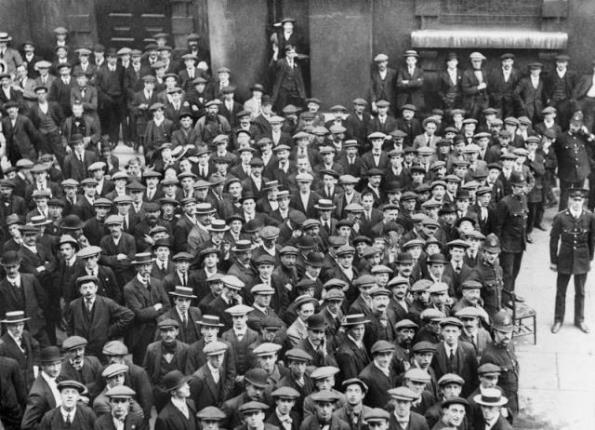
I never had the chance to meet my maternal grandfather and my mother had scant opportunity as, like so many of his generation, he was killed in 1916 during the battle of the Somme when she was three. I certainly have some of his traits which makes me wonder what he’d make of the country he gave his life for. He’d joined the territorial army well before the war started and was an N.C.O, so he must have thought something was worth fighting for. Neither am I sure what my father would have thought of modern Britain, he died soon after Heath signed us up for the Common Market. He never said much about ‘the war’ but I do know what he thought about Dunkirk and the Blitz on Coventry as he was at both.
Anyway, whatever it was my grandfather and father both thought they were fighting for – and many seemed not to have the slightest idea apart from what they were told in the media – I’m fairly sure what they got was not what they thought they were going to get which was, I think, protecting the right to free speech and freedom from fear, and if you would have asked what he meant by free speech he would have said something along the lines of ‘anything you like so long as it is not against the law, decency, and not morally wrong.’ Not particularly contentious at the time, my guess is you would have heard something like that from most people.
Was free speech allowed during the war then? Hardly. Just what the great unwashed thought about the shambles of Dunkirk, the fall of Hong Kong, Singapore, the sinking of the Prince of Wales and Repulse will never be known, as free speech and comments hiding behind the false veil of the need for national security was banned for the national good.
The Daily Mirror came the closest to being banned for its comments but in the main the establishment’s view prevailed and the rest of the population just shut up. Publishers, supposedly the flagship of freedom, crusades and free speech, even after the war and for years after that just clammed up when threatened with a D notice. Publish and be damned? Journalistic courage or the easy way out?
After the war society seems to have reverted on the surface to the ‘mustn’t grumble know your own place’ – well, on the surface anyway, a sort of 1930s part two with still some deference to the established order and ‘the men in Whitehall know best’. Well that’s what most the media told them anyway. Note I said ‘on the surface’: an older friend I knew who was at a certain midlands university reading medicine in the late 40s told me they had a wonderful time, one couldn’t walk down the main drive in the darker evenings without tripping over copulating couples. ‘Well I never’, I said!
So, the beginnings of the sexual revolution then came along with ‘do what you want and say what and when you want’ attitudes within the law (don’t be so judgemental!), decency, and not morally wrong. (What a minefield that would have been – and still is. Do remember though that at the time most thought themselves as being Christians or having Christian values and sort of knew what was expected.)
Cracks in the generally accepted consensus of what you said and what you did started to appear, on the one hand the bolshie ex-servicemen, the barrack room lawyer type, the Jack the lad type: ‘you aint telling me what to do’, and on the other hand, still deference to the establishment.
The ruling class, the ‘officer’ class, many of whom trading on what they had been or thought they had been in the war, were easy targets for the new breed of Angry Young Men. The authors of Private Eye, the makers of That Was The Week That Was all had a field day under the guise of ‘satire’. ‘Wasn’t political satire much worse in the eighteen century?’ they implied correctly, and wasn’t it OK to attack the elites because, well, we’re the new young intellectual elite, we went to the same universities as these people, we know how they work and how their minds work. The young and the not so young middle classes lapped it up. TW3 was a long-term hit. The boundaries of the envelope, as we used to say, were pushed to the limits and far beyond by the intellectuals, leftie political commentators and celebrities,
There was opposition to all this. Mary Whitehouse had a huge audience for her stance that the BBC had gone too far and what was presented, well that was just not wanted in her and others’ version of what they saw as ‘society’ – presumably a sort of god fearing, polite, well read paternalistic (she was a teacher!) middle class society where you looked out for others and always said pardon if you coughed as you walked alone across the car park.
[To be continued tomorrow in Part 2]





“Publishers, supposedly the flagship of freedom, crusades and free speech, even after the war and for years after that just clammed up when threatened with a D notice. Publish and be damned? Journalistic courage or the easy way out? ”
One of the great failures in recent years has been the collapse of proper journalism.
JF
Yes Norman, that is a fair set of comments, and many Thanks.
My family contains stark differences. Grandfather was a Conscientious Objector for WW1. In 1913 he was taking his soap box to our Market Square, with his ‘War.- We say No’. He was a lay-preacher for the Baptist Union. A staunch Socialist and Manager of a grocery Co-Op. Upon his refusal to enlist in the Army, he was taken out of grocery and made a farm labourer. His Son, (my Father), went through his early schooling being taught by Masters who had an arm or a leg missing. – This boy did not have an easy schooling !
Being just the right age, upon Chamberlains declaration, my Father joined the RAF, and after training spent over two years on the North African desert, being shot at by Italians then by Germans. His Squadron was moved to Ceylon, just in time for Japan’s strafing of his airfield, thence to India and with malaria doing its worst, a troop ship home. Just in time for the Normandy invasion. – Through Northern France, Belgium, Holland, and in Germany for the several surrenders being signed. As a Senior NCO he had to be a witness at Belson Camp for forthcoming war trials.
Interestingly, at age 15, I was sent to an Officer Cadet training ship, and for two years loved every moment. It had the effect upon me, and all the other Cadets, of sorting out our bodies, minds and values for life. The discipline was a shock at first, but soon became part of the training. It is no wonder that almost all of us, that I am still in contact with, are firm Brexiteers who love our country. We were brought up right. Trained correctly and understood values in life !
But then (materialistically at least) we’ve never had it so good.
Can we have both big government and freedom too? Before WW2 in our mill village of some 2000 people only about a dozen people paid income tax!
Since WW2 there was no stopping the growth of the state as people bought into the social welfare deal that if you pay the state a few coppers every week they will use that money wisely and look after you from cradle to grave.
Bet they would not have signed up to it if you had told them that future generations would have to work for five months of the year to May 30th onwards before you would be working for yourselves (Current tax freedom day 2019)
Until people are prepared to take full responsibility for their education, health, welfare and personal financial liabilities then there is little chance of reducing big goverment and its tentacles into every facet of our lives including freedom of speech.