
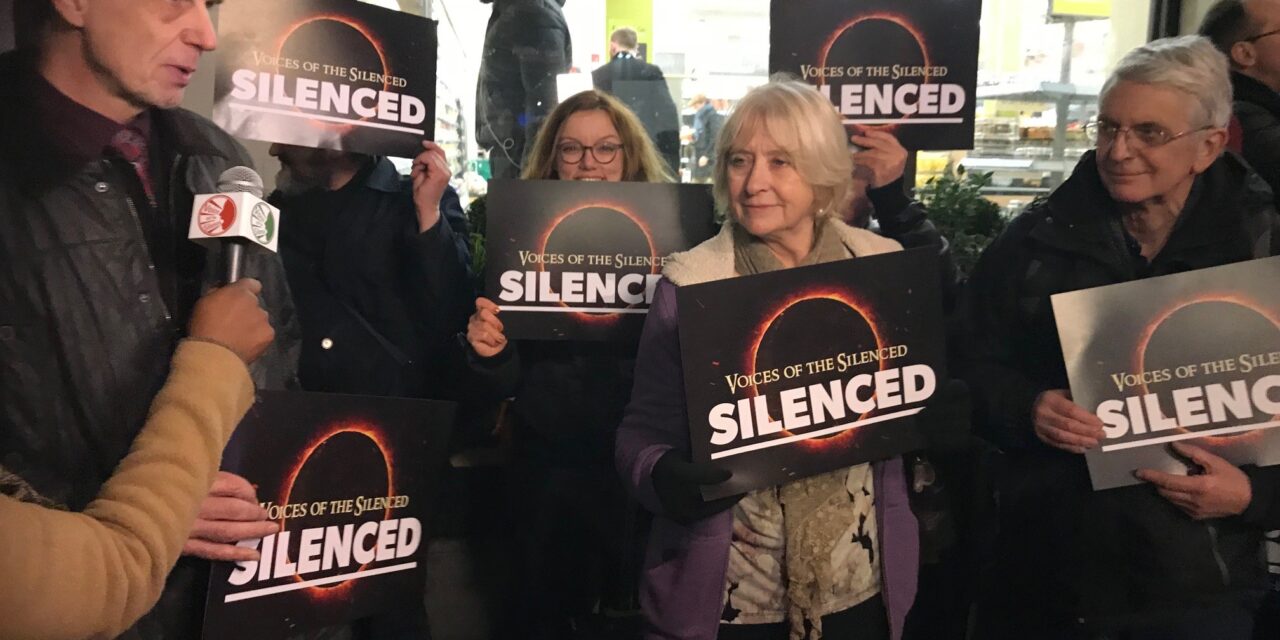
Written by Classical Liberal
~~~ *** ~~~
The largest part of a country’s population that consists of people who are not actively involved in politics and do not express their political opinions publicly. (Definition of ‘The silent majority’ by Merriam-Webster)
I believe that many of us who vote – or voted – for UKIP do so because we feel that the main political parties either take our votes for granted or don’t care what we want. We are part of ‘the silent majority’ that the major parties feel they can ignore. Especially the Labour Party, which has forgotten its traditional supporters, the white working-classes, as it pursues minority groups and progressive causes. Donald Trump harnessed the power of ‘the silent majority’ to win the 2016 US Presidential election. In many ways, the Leave vote in the EU referendum was a victory for ‘the silent majority’; despite the Establishment’s best efforts to thwart the will of the people. Of course, it doesn’t always work. Witness Trump’s failure to repeat his success in 2020.
‘The silent majority’ is an unspecified large group of people in a country or group who do not express their opinions publicly. The term was popularised by US President Richard Nixon in a televised address on 3 November 1969. He said, ‘And so tonight—to you, the great silent majority of my fellow Americans—I ask for your support’. It referred to those Americans who did not join in the large demonstrations against the Vietnam War at the time, who did not participate in the counterculture, and who did not participate in public discourse. Along with many others, Nixon saw this group of Middle Americans as being overshadowed in the media by the more vocal minority.
Preceding Nixon by half a century, the term ‘The Silent Majority’ was employed in 1919 by Calvin Coolidge‘s campaign for the 1920 Presidential nomination.
In 1919, Madison Avenue advertising executive and Republican Party supporter Bruce Barton employed the term to bolster Calvin Coolidge‘s campaign for the 1920 Republican Presidential nomination. Barton portrayed Coolidge as the everyman candidate in Collier’s magazine: ‘It sometimes seems as if this great silent majority had no spokesman. But Coolidge belongs with that crowd: he lives like them, he works like them, and understands’.
The contemporary concept of a ‘silent majority’ derives ‘deeply from Richard Nixon’s basic political orientation’, said Rick Perlstein, a historian. He has written multiple books on conservatism and the Nixon era, including Nixonland: The Rise of a President and the Fracturing of America and The Invisible Bridge: The Fall of Nixon and the Rise of Reagan.
In 1955, Nixon was serving as Vice-President to Dwight D. Eisenhower. John F. Kennedy wrote in his book Profiles in Courage, ‘Some of them may have been representing the actual sentiments of the silent majority of their constituents in opposition to the screams of a vocal minority…’ In January 1956, Kennedy gave Nixon an autographed copy of the book. Nixon wrote Six Crises, some say his response to Kennedy’s book, after visiting Kennedy at the White House in April 1961.
In 1967, labour leader George Meany asserted that those labour unionists (such as himself) who supported the Vietnam War were ‘the vast, silent majority in the nation’. Meany’s statement may have provided Nixon’s speechwriters with the specific turn of phrase.
In the months leading up to Nixon’s 1969 speech, his vice-president Spiro T. Agnew said on May 9, ‘It is time for America’s silent majority to stand up for its rights, and let us remember the American majority includes every minority. America’s silent majority is bewildered by irrational protest…’ Journalist Theodore H. White analysed the previous year’s elections. Writing: ‘Never have America’s leading cultural media, its university thinkers, its influence makers been more intrigued by experiment and change; but in no election have the mute masses more completely separated themselves from such leadership and thinking. Mr. Nixon’s problem is to interpret what the silent people think, and govern the country against the grain of what its more important thinkers think’.
On October 15, 1969, the first Moratorium to End the War in Vietnam demonstration was held, attracting thousands of protesters.
Feeling very much besieged, Nixon went on national television to deliver a rebuttal speech on 3 November 1969, where he outlined ‘my plan to end the war’ in Vietnam. Nixon stated his policy of Vietnamization would lower American losses. As the South Vietnamese Army would take on the burden of fighting the war. He announced his willingness to compromise provided that North Vietnam recognized South Vietnam. And finally promised he would take ‘strong and effective measures’ against North Vietnam if the war continued. Nixon also implicitly conceded to the anti-war movement that South Vietnam was not very important. He maintained that the real issue was the global credibility of the United States as he stated his belief that all of America’s allies would lose faith in American promises if the United States were to abandon South Vietnam. Nixon ended his speech by saying all of this would take time. And he asked for the public to support his policy of winning ‘peace with honor’ in Vietnam. As he concluded: ‘And so tonight, to you, the great silent majority of my fellow Americans—I ask for your support. Let us be united for peace. Let us be united against defeat. Because let us understand: North Vietnam cannot defeat or humiliate the United States. Only Americans can do that’.
In one line of his speech, Nixon called out the anti-war movement directly, speaking of protesters in San Francisco carrying signs that read ‘Lose in Vietnam. Bring the boys home’. ‘As president of the United States’, Nixon said, ‘I would be untrue to my oath of office if I allowed the policy of this nation to be dictated by the minority who holds that point of view and who try to impose it on the nation by mounting demonstrations in the street’.
The public reaction to the ‘silent majority speech’ was very favourable at the time. The White House phone lines were overwhelmed with thousands of phone calls in the hours afterward as too many people called to congratulate the President for his speech.
Thirty-five years later, Nixon’s speechwriter Pat Buchanan recalled using the phrase in a memo to the President. He explained how Nixon singled out the term and went on to make use of it in his speech: ‘We [had] used “forgotten Americans” and “quiet Americans” and other phrases. And in one memo I mentioned twice the phrase “silent majority”, and it’s double-underlined by Richard Nixon, and it would pop up in 1969 in that great speech that basically made his presidency’. Buchanan noted that while he had written the memo that contained the phrase, ‘Nixon wrote that speech entirely by himself’.
Nixon’s ‘silent majority’ referred mainly to the older generation (those World War II veterans in all parts of the US). Still, it also described many young people in the Midwest, West, and the South, many of whom eventually served in Vietnam. ‘The Silent Majority’ was populated mainly by blue-collar white people who did not participate in politics: suburban, exurban and rural middle-class voters. They did, in some cases, support the conservative policies of many politicians.
In his famous speech, Nixon contrasted his international strategy of political realism with the ‘idealism’ of a ‘vocal minority’. He stated that following the radical minority’s demands to withdraw all troops immediately from Vietnam would bring defeat and be disastrous for world peace. Appealing to ‘the silent majority’, Nixon asked for united support ‘to end the war in a way that we could win the peace’. The speech was one of the first to codify the Nixon Doctrine, according to which ‘the defense of freedom is everybody’s business—not just America’s business’. After giving the speech, Nixon’s approval ratings hovering around 50% shot up to 81% in the nation and 86% in the South.
(To be continued with Part 2 tomorrow)






That JFK gave Richard Nixon an autographed copy of his book “Profiles In Courage” is not the only thing that surprises people about the Kennedy family.
Bobby Kennedy, JFK’s younger brother, asked Senator Joseph Raymond McCarthy to be the godfather of his first child Kathleen, born on 4th July 1951. That was seventeen months after McCarthy’s speech at Wheeling in West Virginia (demanding that communists be sacked from the top of the US federal government) had earned McCarthy the fury of the American media establishment.
RFK worked for McCarthy in his office after Wheeling in the early 1950s, one of only about six people brave enough to do so. And when a speaker casually linked Joe McCarthy and Alger Hiss together, JFK shouted out at him “How dare you couple the name of a great American patriot with that of a traitor?”
Tricky Dicky, well named I always thought of him as , slimy and not to be trusted and that was before Watergate.wasn’t he the President who made the first overtures to China.to become a ‘favoured’ nation?
In my opinion that was the greatest mistake ever made -_and we are still suffering the consequences to this day.
I’ve no real idea what watergate was about, but from what I read about his trouble with the demonstrating idealists who were anti Vietnam, it wouldn’t be beyond credibility that they were being encouraged and perhaps sustained by the then Democratic Party (the enemy within?
If I was in that Presidential position, I would certainly be desperate to learn the truth of it and feel I need to take action……….
The first and last rule of this sort of situation is not to be caught or found out.
What should he have done?
Well it was not some little fib which could be excused or glossed over
It was one big enormous wrongdoing, it should have been obvious lying could only lead to ultimate exposure of the truth
I believe in owning up in these sort of circumstances, pointing out suspicions that I didn’t trust the FBI to properly investigate and shame the devil..maintain I still held suspicions and if they felt they indeed had nothing to hide, agree to proper investigation.
If they were proved innocent, then would be the time to Tal of impeachment.
Whatever course it is you can’t afford to give in and you have to tough it out to the end, but even if you are proved right, two wrongs can never make a right.
Witness the conspiracy campaign waged by our Remainersto reverse Brexit, they too were in the wrong, but they tougher it out to the end and they haven’t been gaoled or impeached yet and this silent majorician” wants to know why.
Some years ago a poster here put up a youtube video regarding the silent majority.
I couldn’t find it on this Blog, but below is the flavour of it.
It was a panel discussion. A muslim woman spouted off the usual we are the silent majority, not muslim killers who are almost non existant.
.
The lady on the panel turned on her saying (along the lines of):-
– the silent majority did not stop Mao Tse Tung killing millions of his own people
– the silent majority did not stop Pol Pott killing millions of his own people
– the silent majority did not stop Adolf Hitler killing millions of jews
– the silent majority . . . and on
The muslim woman went away looking like a whipped dog.
Like safety and security, you have to think long and hard before making pronouncements.
Early on CL writes of speaking for the “silent majority” : “Of course, it doesn’t always work. Witness Trump’s failure to repeat his success in 2020.”
So CL, you don’t think that the 2020 U.S. Presidential election was stolen? Stolen by fraudulent postal votes fabricated by Dem Party activists, which were still being counted a week after polling day?
Maybe we will see some retribution yet; it does seem that plans are being made behind the scenes. Let’s hope so.
Nixon seems a strange choice for Classical Liberal to make. A memorable catch phrase doesn’t make a ‘good’ person or politician.
Shame. I usually like Classical Liberal’s posts.
“I believe that many of us who vote – or voted – for UKIP do so because we feel that the main political parties either take our votes for granted or don’t care what we want… ”
Fair comment… The author then says, “We are part of ‘the silent majority’ that the major parties feel they can ignore…”
That is NOT true. They do not ignore us. They are terrified of us. That is why we are effectively gagged.
We have no voice. The media, be it radio, television, Social media, or the newspapers make sure that our opinions are never heard and that if they are, they must be denigrated and branded as Alt-right, Racist, Neo-nazi, Islamophobic or homophobic, take your pick.
Factual evidence is ignored. Debate is suppressed. The UNI-Party has made it plain that any dissent will be crushed with all the powers that the State has at its disposal. You have all see examples of this, from the treatment of Tommmy Robinson, to the arrest of an elderly Christian Pastor for quoting the Bible.
Regrettably this is not confined to the UK. We must ALL be reduced to the lowest common denominator in readiness for “Building Back Better,” or One World Government and “The New Normal”.
I couldn’t agree more Dick.
And me.
Me too Dick, but our time will come.
Very well said dickatbarn. Agree 1000%
Dickatbarn, where did you find the two quotes from the author at the start of your 2.23 pm comment ?
Thanks dickatbarn
“They do not ignore us …….they are terrified of us so they gag us”
So true, great slogan to be remembered!
Presume the silent majority are those who believe in the rule of law, the nation state, small government, putting British people first, balanced budgets, controlled and low immigration, traditional family values, etc.
If the so called silent majority feel they are not being listend to then much of the problem lies in their own reluctance, for whatever reason, to engage in active politics. The progressives and liberals of all shades actively engage in politics and they have effectively won battle after battle because of their prepardness to sacrifice time, energy and committment to further their beliefs and political agendas.
Anyone who identifies themselves as members of the aggreived silent majority and continues to vote for the rigged LIB/LAB/CON musical chair scam should look in the mirror if they want someone to blame.
Any former UKIP activist will know exactly where I am coming from if they spent any time on the doorstep campaigning.
Jake, that’s all very well, but –
I for one am too old and infirm to engage in active politics.
Also, at the moment there is nothing viable to support, or even vote for.
I don’t think Ukip ever was a one issue party and it certainly did not ‘deserve’ to die once the referendum was won. At the moment, nationally, there is nothing available even if there was a G.E.
Your opening paragraph sets out a reasonable manifesto but it is not fair to blame the silent majority for not supporting it, I.M.H.O.
Pauline. Oh! But you are active, if not in the wearing out of shoe leather, activism league! You write to your MP and your local paper, you sign petitions, you write eloquently in these columns, you would become a member of a challenger party and I have no doubt you would put up a poster in your backyard to support an independent or one of the challenger parties.
We had members of our UKIP branch who would not even put up a UKIP poster in their window or deliver leaflets in their own streets even during the referendum!!!!
Today, I voted for an independent in the Police and Crime Commissioner elections and would have voted NOTA if I did not get the opportunity to vote for an independent or an agreeable challenger.
A vote for LIB/LAB/CON/GREEN puts a nail in the coffin of challengers and perpetuates the musical chair party politics.
Jake my husband and campaigned extensively for UKIP. Three of our merry band got seats on the local Council. The last of the three now sits as an Independent.
Now my husband is disabled with RA and I am his carer. I am still ‘agitating’ and harassing my MP. Today I used the ‘NONE’ tactic on two out of the three voting papers because there was no candidate other than LibLabCon. The third form had an Independent.
Our political system is a corrupt mess. Somehow the young need to be brought on board to accept the banner for ‘change’! They are the future!
Frederica. Well done! NOTA every time if there are no suitable independent candidates. And yes you have hit the nail on the head – our political system is a corrupt mess. MPs and their parties respond and accomodate those who shout the loudest, those who constantly put them on the spot and demand change, those who promote the NGO and globalist agenda, those who afford them second incomes and those who donate monies to their party. And that is exactly what the progressives and cultural Marxists are doing and playing a very long game too.
We have no alternative but to be active in whatever way we can be according to each and every one of our abilities or we should just shut up and spend more time in the garden. The political system will never, ever respond to those who expect them to reform or do the right thing. Modern politics respond to those who make the most noise and threaten the livelihoods of career politicians – didn’t we get Brexit that way?
I do not believe this person.
Everything said aims at destroying basics. The Silent majority debate ( so called debate ), is a peurile attempt to support him/her/it self in some hidden objective.. Every time it writes something he debases something.
Dreadful. Warped .
The purpose of part 1 would seem to be to gain sympathy, then familiarity, then alignment and finally acceptance of any disinformation it attempts to spread. Very very bad.
The proper response to this is ” So what “, or ” If you’ve got something to say, this ain’t helping “. or ” yeah ?”.