
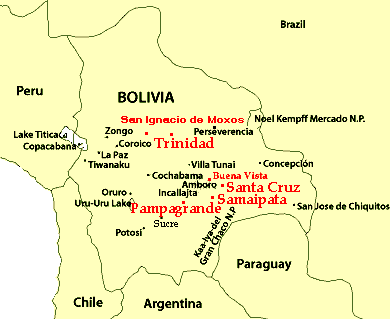
Map of Bolivia
[You can read Part 1 here and Part 2 here]
BUENA VISTA AND THE AMBORO NATIONAL PARK
Having a few days to spare we decided to visit the Amboro National Park, a few hours run from by taxi for Santa Cruz. We had been informed about the “Hotel Flora Y Fauna” run by one Robin Clark, a well known British ornithologist. This place was quite well appointed and hence expensive by local standards. (Still cheap by first world standards). If you are a twitcher this is the place to visit, you will find yourself in like minded company. Bird watching walks are virtually compulsory. The Amboro National Park is a controversial topic in Bolivia. This once pristine wilderness park is now in the process of being burnt down by campesinos (peasant farmers), but then so is the rest of Bolivia. Many campesinos were displaced from the Yungas and Chaperra areas due to the recent crackdown on coca growing.
It seemed wise to view what remained before it disappeared. The day before our intended journey we carefully investigated the whereabouts of the taxi service to Buena Vista (Calle Isoso near to the bus station). This turned out to be a totally unnecessary precaution because as we stepped from the hotel a taxi screeched to a halt and within thirty seconds we were ensconced. The city taxi drivers normally never leave Santa Cruz, however it turned out that the driver had family in Buena Vista and was not averse to a trip out there at our expense. After a sub tour to confer with his mates as to the price and a long consultation over the map, we finally arrived at a price of 130 Bs. (£13) Buena vista is on the new road to Cochabamba and tolls have to be paid. The road is good.
Our taxi driver was clearly in high spirits at the prospect of a break from his routine, especially when I included him in our refreshment stop. He became imbued with a desire to find out just how fast his taxi could go, fortunately no more than 100Km/hr. It had almost 300,000Km on the clock. (He was mad as are all Bolivian taxi drivers.)
It was a Toyota Corolla estate, second hand from Japan. This meant of course that it had been a right-hand drive. This had been locally remedied by moving the steering column and the pedals to the left. However all the instruments and switches remained on the right, together with the big hole where the steering column once was. Nearly all the taxis in Santa Cruz have this setup.
During the latter part of the dry season the campesinos traditionally burn down their forests and grassland. This results in the worst smoke pollution I have seen anywhere. Anyone with asthma or other pulmonary problems is well advised not to visit Eastern Bolivia during August/September/October.
On this day conditions were particularly bad, visibility being reduced to fifty yards on occasion. The driver referred to this as “neblina” which I took to mean fog from my knowledge of German, “Nebel”, he was amazed when I suggested it was “fumar” (smoke). At night the atmospheric inversion lowers, bringing down all this pollution and we sometimes found it hard to sleep, conditions were so bad in this area. We rolled up at the “Hotel Flora Y Fauna” in the late afternoon. It is set in it’s own patch of rain forest and run by one Robin Clark. Ornithologist and long time resident in Bolivia. It’s a very nice place to stay but the catering arrangements are chaotic to say the least.
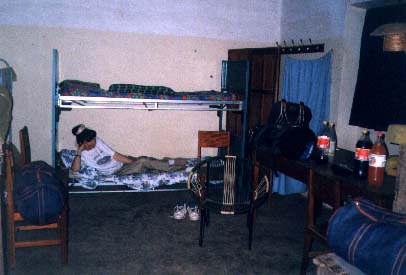
One often has to forage in the kitchen or issue instructions to the kitchen staff in order to eat, our Robin being more concerned about bird watching. There is however a refrigerator always full of free beer! Bird watching walks in the local forest are practically obligatory. There are towers set up here and there for this purpose. Amongst lots of other birds we saw severe and yellow-collared macaws, as well as several unidentified conures. We also saw trees with macaw nest holes.
Several years ago Robin carried out a survey of the Ara Rubrogenys and probably knows more about them than anyone else. This was with the object of preserving them and their habitat, however as usual in Bolivia, nothing whatever has been done. The situation has deteriorated considerably since then. This was our last port of call in Bolivia. The total cost of our holiday was £1200 per person (four weeks, including airfares, local tour costs and donation to Hermano Andres). Travelling about was no problem. No-one hassled us. We met lots of nice people, some of whom put themselves out considerably for us.
On our last day in Santa Cruz it was the founding day of the city. This was an excellent excuse for celebration in the Plaza. The President of Bolivia was there. The army was there and there were numerous folk dancers. The Presidential party was ensconced on a dais. Local dignitaries reclined on armchairs in the shade of the trees. The army sweated it out in the heat of the sun. There were speeches, the army stood at ease for civilians and at attention for military officers.
Interesting for Brits, the army sang the National Anthem and various martial airs. They also paraded past the President goose stepping. The Bolivian style is kicking very high, many of the participants seemed about ready to collapse afterwards. When the bash was over, the dignitaries circulated amongst the crowd. Even a passing gringo could have buttonholed any member of the government/armed forces supposing his Spanish had been good enough.
This visit took place in 1999 so some things will have changed. Bolivia is a great place to visit stunning scenery with less hassling of tourists than Peru. The great thing about third world countries is the low cost of living but possibly a little basic. Few can afford a car so public transport is extensive and cheap (though a little basic at times).
Some of the buses look like mobile rabbit hutches but they are the ones going to interesting places. The really remote (usually extremely poor) places are served by trucks. I always entertain suspicions about internal flights in South America where maybe essential maintenance could be dodgy.
~~~ THE END ~~~






” (He was mad as are all Bolivian taxi drivers.)”…. Bolivia isn’t the only place with mad taxi drivers. I was in another tropical country in the last century where they drove on both sides of the road between the airport and the big city. With car horns blasting to other drivers to get out of the way. Head on collisions were only avoided at the last moment when one driver swerved. The one who swerved first was a sissy. City roads were too jammed to play that game, so they made up for it by blasting their horns the whole time at other drivers near them in the heat & smog.