
(You can read Part 1 here and Part 2 here)
THE SANTA CRUZ ZOO
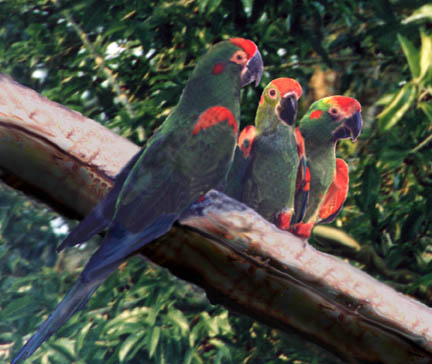
We also visited the Santa Cruz zoo one of the largest in South America. This is a zoo in the old fashioned sense. Here is imprisoned virtually every creature to be found in the continent. There is just about every macaw you can think of including eight blue-throated macaws and about fifteen red-fronted macaws. In tiny cages is the mighty harpy eagle (which dwarfs the golden eagle) and the giant Andean condor. Urchins throw popcorn at rare spectacled bears. The maned wolf has disappeared. Local conservationists say this place is a clearinghouse for collectible animals that appear and disappear regularly. Birds confiscated by customs and park rangers are sent here. None have ever been released.
CONSERVATION IN BOLIVIA.
Bolivia has had a turbulent history but today things are pretty quiet. Everywhere we went we were treated with kindness and consideration. There are many national parks in Bolivia, many are under some sort of threat, notably the Amboro national park. However, we discovered a black side to Bolivia concerning the animal and bird trapping industry which is still alive and kicking. There are concerned people in Bolivia, however many are under threats from the local wildlife trappers and are afraid to raise serious objections to the practices they see going on around them.

Local conservationists have received death and bomb threats. Cocaine was planted on the premises of another and the DEA informed. Fortunately, he spotted the perpetrators and was able to dispose of the drugs before the police arrived. (The consequences could have been a long term in jail.)
The wife of another was kidnapped, beaten up and raped. She has since left Bolivia.
Shortly before we visited one, the forest around his house was deliberately burnt down, the house barely escaping.
Some local conservationists keep firearms in the house in case of an attack.
The famous naturalist, Noel Kempff was murdered, officially by drug traffickers. Locals however say animal trappers were responsible.
Remember when you buy a wild-caught bird, this is the kind of people you are supporting.
TRAVELLING TO AND ABOUT BOLIVIA.
Bolivia is one of the poorest countries in South America. Once you get there you will be rich, well able to hobnob it with the wealthy and the beautiful. There are two international airports La Paz and Santa Cruz, the latter being best for parroty Eco-tourists. It will cost between £600 and £700 to fly there from the UK. (We got our tickets from Journey Latin America and flew with “Aerolineas Argentinas” and excellent they were too.)You can live in Bolivia for £50 a week, for £100 you can enjoy some degree of comfort. £200 buys luxury, at least where it’s available. Many Bolivians live on £2 a week.
You will definitely need your “Lonely Planet” Bolivia book.
You can fly to most towns. You can go anywhere by bus, or truck where the roads are bad. On some a 4×4 is necessary. You can travel long distances by taxi cheaply. (Taxi drivers are open to any kind of deal.) Bear in mind that most of the minor roads and some major ones can close due to heavy rain. Flooding, avalanche, and mud take their toll. The wet season in Eastern Bolivia is usually from November to April.
Avoid foreign operated tour companies, they are vastly more expensive than the locals and offer no better service. I like to make sure my money stays in Bolivia, the people there have more need for it!
The bus service to Trinidad is by night and takes about twelve hours, (£6). “COPACABANA” is the most comfortable (insofar as the word can apply!) See the “Lonely Planet” book for details. The road is mostly dirt but good by local standards.
There are plenty of hotels, the one we stayed at was the “Monte Verde” on Avenida 6 de Agosto No 76. (English is spoken by the manager who is also very helpful.) The rooms here are clean, bright and of reasonable size. Breakfast is available. Also, there are several glass and chrome cafes on the Plaza which are open for breakfast.
There are many and varied National Parks in Bolivia, all have something to offer. Some are easy to visit, some are almost impossible. (We failed on this occasion to get into the best known of all, the remote Parc Nacional Noel Kempff Mercado.)
The total cost of our trip this year for five weeks in Bolivia including airfares was £1200 per person (1999 prices), half of this being airfare. We could easily have cut £200 from this figure. The research is done, there is no reason not to go
!THE “MACHETERO” CULT OF BENI.

Readers may remember my investigation into the devil dancers of Panama and their macaw head-dresses a few years ago. I had heard that a similar thing was going on in Bolivia, centred on the town of San Ignacio de Moxos, 60Km to the West of Trinidad. We made a journey out there in order to investigate. This included living on a packet of “Pringles” between the two of us for two days (tasty and nourishing when you’re sufficiently hungry!) We travelled to San Ignacio by camíon (truck) from Trinidad. The dirt road has three river crossings by ferry, there are no buses.
I can now tell you that macaw feather head-dresses are used in processions that take place not only in San Ignacio but in Trinidad and other towns. There are two aspects to this, one is by male-only ethnic Indians in a pagan cult that has somehow infiltrated the local churches. The other is as a commercial/tourist fiesta that includes women and non-Indians.
There is a flourishing industry, shooting macaws and manufacturing head-dresses and other items of which we were only able to locate the tip. Bolivia is a signatory to CITES but it seems that this is being totally ignored. We discovered a grisly little shop in Trinidad where macaw parts were for sale. For example, you could buy the wing of a green wing macaw for £2. The skull (picture, 37K) costs about £0.50. The head-dresses were there as well.






How sad that these lovely creatures can’t be left alone. Would be an earthly paradise but for certain humans and their greed. Would love to go there.