
Written by Helena Windsor
In his open letter to Sajid Javid and Grant Schapps, published here on July 9th , Anthony Webber claimed that –“they have used PCR testing with a CT value of 45 to manufacture False Positives to prolong the pandemic”.
I confess, I have never carried out a Covid PCR test, but the beauty of this technique is that everything is much the same but for your carefully selected pair of oligonucleotides (oligos) known as primers, which seek out the target sequence on each DNA strand. Scientists can order custom made oligos to their own specification from a number of companies or, for some tests, buy in a kit marketed for specific functions.
Mr Webber also stated that the PCR can detect other viruses which cause common cold symptoms such as parainfluenza, rhinoviruses or enteroviruses. Indeed it can if your reaction well contains the right primers, but SARS CoV-2 primers won’t work with these unrelated viruses. They shouldn’t even work with other coronaviruses – specificity is an important part of test development. Tests can be generic – ours is designed to detect most members of a family of micro-organisms – or highly specific, to detect species or sub species. You can even look for antibiotic resistance by testing for bacterial resistance genes.
When a sample comes into the lab the first job is to burst open cells with a ‘lysis buffer’ and then extract the nucleic acid. Covid swabs may arrive in a tube which already contains an ‘inactivating agent’. Our extraction is done robotically: automation makes for a more controlled, less contamination prone process. Nucleic acid extracts are added to test vials or small wells in a tray together with what is known as Master Mix. Note that I refer to ‘nucleic acid’, this is because some viruses like SARS CoV-2 and HIV have RNA, not DNA as their genome. These will need the addition of another enzyme, reverse transcriptase, to generate complementary DNA from the virus RNA. It is this cDNA that is amplified in the heating cycles.
Master Mixes contain all the enzymes and chemicals needed for the reaction – the nucleotide building blocks, Taq Polymerase and selected probes and primers. Probes are the chemicals responsible for generating fluorescence in Real Time PCR (RT-PCR) when DNA replication and amplification takes place. There should also be an ‘internal control’, unrelated DNA which, when amplified, confirms the reactions are working when the test well is negative. For the reaction the prepared samples are loaded into a thermal cycler. This is the device that heats the samples until the two strands of DNA separate. As the sample cools, the enzymes get to work on the template to double the number of pieces of target DNA. Then the process is repeated: heat and cool, separate and anneal. If the target DNA, complementary to the primers, is present the number of copies doubles with every cycle.
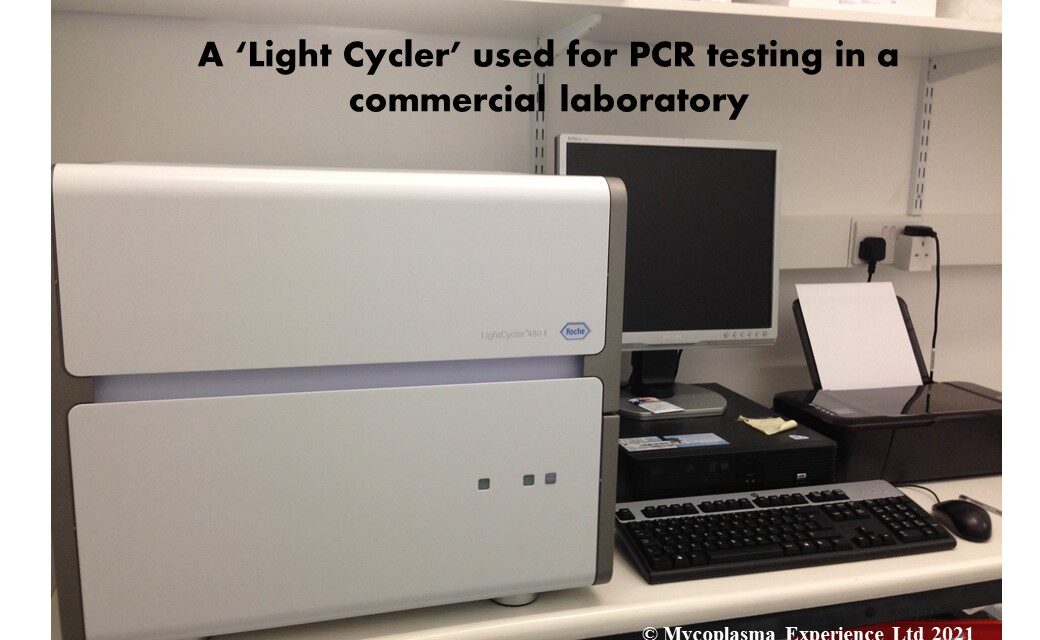
Early PCR tests detected the amplified DNA in samples by running them through agarose gels, then applying a dye to visualise the DNA. This creates the ladder pattern familiar to those who have seen photographs of, say, Forensics work, searching for evidence of the suspect’s DNA at the scene. RT-PCR, allows the reactions to be followed as they happen. This is where those fluorescent ‘probes’ come in, using thermal cyclers with a light source to detect the emerging fluorescence. This is the method we use in our laboratory and is also used for Covid testing. We load a tray of 96 small wells containing samples and positive and negative controls into our light cycler, choose the correct programme and press the ‘start’ button. The instrument and its software does the rest. We see the reactions as a graph on the screen. The more target DNA present in the original sample the quicker the fluorescence is detected by the instrument.
How many heating cycles do we use? The instructions for use in our kit recommends 45. Yes, that’s right, 45 cycles, just like the protocol for Covid tests.
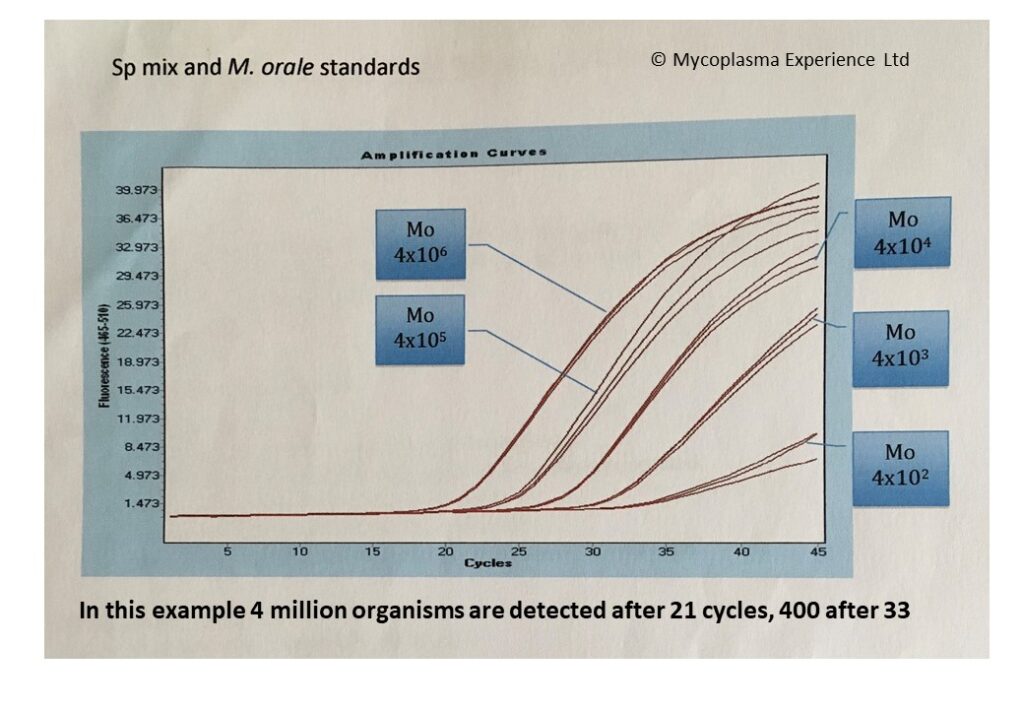
If you put in a Freedom of Information request asking how many cycles are used you will be told 45 – perhaps it’s the wrong question. How quickly will positive tests be detected? The Government’s own publications have observed that “PCR cycle threshold (Ct) values appear to be persistently lower in Delta than Alpha cases based on routine national testing data”. The Ct value is the point where the fluorescence is detected: the more target DNA in the sample the fewer heating cycles. In the same publication the mean lowest Ct value for the Alpha variant in the study period was 19.7 and 18.5 for Delta. Take home message: if you are infected with the Delta variant you are shedding a lot more, which probably accounts for the high transmission rate.
In our tests we have to be able to detect low levels of our target. Our low number positive controls typically give Ct values around 35, a recent positive sample, 19.3. Government figures show a Covid test range from less than 20 to 35-38. “Everything will be positive after 45 cycles”? I have seen this claim so often – sorry, our lab’s negative controls and samples are still negative at the end of the 45 cycle run! If a test was unstable in a 45 cycle run – and this can happen – the test protocol isn’t working. The fault would normally show up in the negative controls too.
In summary, it is thanks to Kary Mullis and the scientists and engineers who expanded and refined his original concept, that rapid development of a sensitive, accurate test for SARS CoV-2 and worldwide deployment was possible. This is remarkable, yet there are those who have demonised the PCR test, even claiming, circulating amongst certain groups, that 95-100% of positive tests are false positives. The RT-PCR method is far less at risk of false positives from cross contamination than the gel method, false negatives, especially from an inadequate swab, are more likely. As noted earlier, if the test specificity is good, false positives from misdiagnosis of other infections are unlikely.
However, as a microbiologist I am acutely aware of and have frequently warned, that PCR only detects the presence of the nucleic acid. It does not tell you if the organisms are viable. Patients, human and veterinary, clearing an infection, naturally or after antibiotic treatment, can test positive by PCR but live organisms can no longer be cultured. I am sure this has happened with Covid but most swabs are routine screens on well people or tests to check symptoms – it would not account, historically or now, for 95% of positives.
Times might have changed though, with the high vaccination rate and the numbers who have recovered from Covid. Are some, even all, of the current asymptomatic positive tests actually detecting SARS CoV-2 nucleic acid where someone has been exposed to the virus and, due to their pre-primed immune system, have been transiently infected and fought it off? Technically this is not a ‘false positive’ but it is definitely not a case.
With the way we are managing Covid now, I believe this warrants urgent investigation.
~~ ** ~~
[Photos courtesy of Helena Windsor who holds the copyrights]





Fascinating article which I admit I found quite difficult to follow but it is a specialist subject. One thing seems to stick out, if I have understood it properly, if you have had an infection of any sort, and had anti-biotics to try and clear it up, the PCR or Lateral Flow test can give a positive result whether it is Covid or something else. I may have misunderstood but that’s my understanding. Can you clarify Helen, thank you. I would also be interested to know your opinion on Ivermectin and hydroxychloroquine with zinc.
Not quite. Say you had antibiotics for tonsillitis and shortly after they had cleared your infection you had a PCR test for the same bacterial species that caused your tonsillitis AND the microbiology lab tried to grow them on agar plates. You might have a positive PCR but fail to grow it. If the same swab was PCR tested for Covid it would come back negative. Lateral flow is an antigen test – detects the bug, not its nucleic acid, so should be negative.
I’m not going to get embroiled in the ivermectin/HCQ + zinc argument because I genuinely don’t know. I believe Ivermectin is active against some viruses in lab tests but one thing I do know is that this does not always translate into good results in real life. Remdesevir was much touted from lab data and early ‘anecdotal’ level studies but it’s proved disappointing.
Right Helena. So many of the positive results are detecting something that has been dealt with. What was it? Sars Cov2 nucleic acid where someone has been infected and fought it off.
So what is all the continuing panic about? In fact what was the ORIGINAL PANIC about?
Definitely a learned article. No one is disputing that you scientists are clever people and thoroughly understand the equipment you use.
The problem all through has been how, unscrupulous people, have manipulated your information for their own ends.
Incidentally, isn’t Sars cov2 nucleic acid common to the other Sars viruses besides Cov19?
What scientists will look for when designing a specific test is a region of nucleic acid that is unique to that species/strain. I don’t know enough about coronaviruses to tell you if there is a conserved region that would pick up the whole family – quite possibly as we know from a study in Singapore that cells from people with immunity to SARS1 and other, unknown coronaviruses cross reacted with SARS2
With my organisms we have PCR kits that pick up the group and specific ones for individual species.
The original panic was a new virus, with unknown properties – and there is still a lot we don’t know. My best educated guess is that most PCR tests people take are genuine if postive unless they have had and are recovering from Covid, when the nucleic acid debris is a distinct possibility. My concern now is that with so many either vaccinated or who have had it, we may be seeing this phenomenon in people who are exposed and fight it off quickly without being ill.
May I concur , Many thanks for this article Helena,
I don’t know if it is fake news, or not, but I have seen a report – supposedly from Centers for Disease Control and Prevention that after 31 Dec 2021 CDC will withdraw the request to FDA for Emergency Use Authorization for the PCR as it has failed it’s full review. Advance notice has been given for clinical labs to have adequate time to select and implement one of many FDA authorized alternatives. It’s a class 1 recall….the most serious type of recall.
Can anyone verify this ? If correct, it has obvious implication for the whole narrative we have been given.
I can’t comment on the quality of the US test protocols but from reports I have seen – and links to CDC notices it looks to me that they want to switch from a test for just SARS CoV-2 nucleic acid to what is known as a multiplex test which will pick up flu A & B and Covid. Multiplex tests, not just PCR but other formats as well, are quite common in oth clinical and veterinary diagnostics where symptoms presented are similar for several pathogens. They combine specific ‘primers’ (for PCR) or bound antibodies on little spots for each disease, in one test. They want to make this switch for winter.
Excellent and informative article; thank you Helena.