
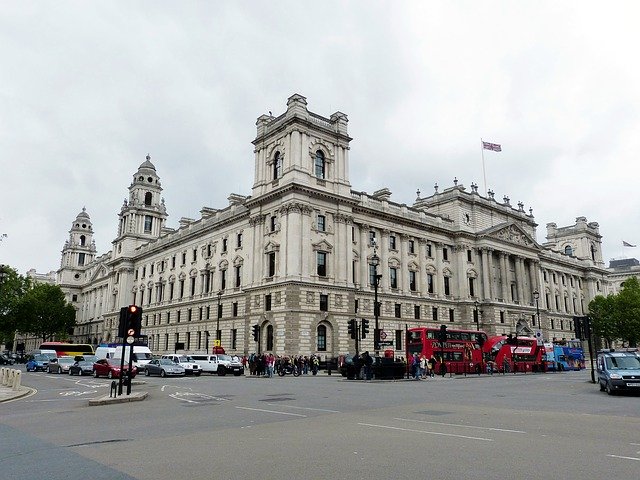
While we mourn, life goes on, especially in Whitehall …
It’s a damp and grey morning, suitable for the day when the coffin of the Queen will go to London, follwong the ceremonies and the respect and grief shown by the people in Scotland. The papers are printing photos of yesterday’s events on their front pages (link), as do the MSM online editions.
The opinion piece writers are again out in force. Some are utterly infantile, like Ms Tominey in the DT, wailing:
“Queen Elizabeth would have wanted Prince Harry to wear military uniform at her funeral – Decision not to allow the Duke of Sussex to wear the Blues and Royals uniform will be viewed by the public as a petty and unnecessary snub” (paywalled link)
Amazing, isn’t it, how that lady ‘knows’ what the Queen would have wanted! If there’s one thing I’ve come to loathe deeply it’s columns such as this one. However, not all are like this. Charles Moore, also in the DT, writes about the address of King Charles III to both houses yesterday, and to the swearing of allegiance of MPs and Lords. His observations are important and I’m quoting at length, for the record:
“The fortune of a nation depends upon the allegiance which people, and especially legislators, give to the structure of the state. That is best symbolised by a non-political head of state rather than a party-political figure.
Both the Speakers in Westminster Hall yesterday reminded us that the sovereign defends our liberties. Odd that it falls to a hereditary, unelected person to do this, yet history has made it so at least, as Mr Speaker Hoyle pointed out, since 1688. At the heart of a successful state, there has to be something that most people do not want to argue about. If that deep thing is secure, you can have any amount of fierce argument on top of it (as is seen in the House of Commons).
The weak point of a hereditary system is the moment of succession, because someone might, as in a relay race, drop the baton.
Because of the new King’s two public utterances so far – one of them being yesterday’s – and also because of his public appearances, we already know that the baton has not been dropped. As the Houses of Parliament formally recognised the new reality, I could see the British constitution working before my eyes. I felt the country was secure.” (paywalled link)
Surely I’m not the only one who hopes that Charles Moore’s words will turn out to be correct in the coming weeks and months. There’s also a comment piece by the historian Andrew Roberts in the DT, worth mentioning. The headlines stand for the whole article:
“In silent crowds and long queues, we see a Britain many feared was lost – Dignified mourning for the late Queen reminds us that traditional British instincts remain the same” (paywalled link).
But life has the unromantic habit of going on, the world doesn’t stop while we mourn. The Westminster MSM have perfected the way of not writing about events when doing so might endanger their precious ‘senior sources’ from drying up. The death of Queen Elizabeth II was and is the perfect ‘excuse’ for their disregarding the sacking of the Treasury top mandarin last week. Given the dire state of the economy it is surprising that this hasn’t received the comments one would have expected.
However, Lord Agnew of Oulton, a minister of state at the Cabinet Office and the Treasury 2020-22, has written a brief comment piece for The Times today. It has the promising title “PM was right to sack Tom Scholar from the Treasury” (link, paywalled). Far from being a ‘sour-grapes’ piece or a piece of ‘Truss all the way’, he justifies this sacking with points which made my jaw drop.
I am going to quote at length from this article, for the record, because this assessment comes from an insider, from someone who has experienced the conditions at the Treasury:
“While there has been an understandable outpouring of sadness at the death of Queen Elizabeth, the removal of Sir Tom Scholar as the lead permanent secretary at the Treasury should be a cause for celebration.
Having worked in his department for nearly two years I saw at first hand the malign influence of the Treasury orthodoxy at play. Whether it was foot-dragging and passive resistance to creating a Treasury office in the north (in Darlington), which he fiercely resisted, or the botched arrangements in the construction of the bounce back loans during the pandemic, all roads led back to him.
It is not surprising to hear cries of dismay at his dismissal from an echo chamber of former mandarins, because that is what they mostly are: a metropolitan elite with their own self-reinforcing prejudices.” (link, paywalled)
Well! I’m now feeling good because this is precisely what I’ve been banging on about for years. The next paragraphs are a specific critique of the Treasury:
“I hope very much that our new prime minister will build on her excellent decision and remove responsibility from the Treasury for driving economic growth. It has no idea how to deliver this. The system obsesses about measuring inputs, counting out the money distributed to departments, but has little clue of how to measure outcomes. Departments are infantilised in their management of money, with savings being automatically clawed back to the centre. This of course removes any incentive to think innovatively, creatively or cost-effectively.
Many would say that it is up to elected ministers to impose their will and that the upper echelons of the civil service are entirely neutral in their political views. This is nonsense. Mandarins have a very strong view of how the world should look and will use every lever available to ensure that their prejudices prevail.” (link, paywalled)
It’s gratifying to see that someone who was ‘in the know’ acknowledges indirectly that it’s the mandarins who govern while our elected representatives are allowing them to do so. Is it because the low calibre of ministers and MPs, or is it because they’re all scared stiff of ‘looking bad’ in the MSM? Here are the concluding paragraphs:
“A couple of vignettes. It took the Home Office three years to convince the Treasury that golden visas (to encourage inward investment) were being issued to bad actors or even possible criminals, and that the system needed to be redesigned or stopped. In another row, the Treasury refused to support the Department for Work and Pensions in properly resourcing it to claw back Covid-related Universal Credit fraud. This was even when confronted with the reality that, without extra resources, it would take seven years.
There are many excellent civil servants in Whitehall and I was privileged to work with dozens of them in the Department for Education, the Cabinet Office, HMRC and the Treasury. Tom Scholar was not one of them.” (link, paywalled)
Let’s disregard the disclaimer: “not all mandarins …” – he would say that, wouldn’t he. Let’s keep in mind though that the top mandarins, especially in the other big offices of state, the HO, the MoD and FO, are of a similar calibre and mindset.
Sadly, we know only too well that one swallow does not a summer make. While there might be hope for the economy, I am wary because, who knows, perhaps this is simply a ‘palace revolution’ of mandarins. Still, as long as there’s hope …



The DT Business section also had an article on the removal of the `inaptly`? named Tom Scholar from the Treasury.
under the heading.
“Scholar`s exit from Treasury should be the first of many”” by Matthew Lynn
Lynn dishes the dirt wholesale.
“He (Scholar) was Cameron`s Chief negotiator with the EU – coming back with precisely nothing”
“….. oversaw the Treasury`s absurd and hysterical Project Fear which damaged Britain`s reputation as a place to invest”
“Over the years since 2016 the Treasury has blocked attempts to take opportunities presented by our departure from EU”
“……… flaws in the management of the Pandemic are becoming glaringly obvious”
“Fraud is running into billions on support schemes………that were far too generous and poorly designed”
“there are three key problems.
First the Treasury has a bias against growth and is committedd to the view that the UK`s ageing demographics, its share of world trade and its weakened commercial base mean it is hopeless to ever expect it to grow faster than 1% or 2% per year and the best it can hope for is to cling on to a decling EU for comfort” (Remember Nigel`s criticism of Cleggy “They think we are not good enough”)”
“Next , it does not believe in enterprise or the power of free open and deregulated markets. To the Treasury Tax Cuts never stimulate faster growth, they simply cost money.Enterprise Zones never become hubs of innovation and entrepeneurship, merely centres of money laundering and tax dodging. Deregulation never accelerates growth, only ever allowing flakes and fraudsters to take unacceptable risks, while the self-employed and small businesses barely exist and new technologies are to be treated with suspicion and perhaps, worst of all the Treasury is far to fiscally cautious………”
“……..the “Treasury View” as Keynes first identified it is intrinsically anti- change ”
“The Treasury machine pretends to be neutral…………But along with the OBR and BoE it forms part of a powerful economic establishment that has dominated UK policy making for 4 decades” (Funny how 4 decades coincides with our membership of the EU – did they go `native` or just take orders?)”
“……… only mass immigration has managed to keep overall output growing at all”
I`m a bit disappointed Lynn`s headline said “…should be the first of many” I hoped for an exposee of many more departments, particularly of the Home Office, which John Reid found `not fit for purpose` and I`m sure still isn`t and defence needs a good purging, and how about Education teaching all that nonsense of gender diversity? Nett Zero and Great Reset Department get rid of `em root and branch.
(Oh well! save yer breath to cool yer parritch Roger! – if we get any response from Truss we`ll wait a long, long time!)
For god`s sake send for Frosty – he`s the only one with even half a clue!
But the Tory Party (mostly) share the same world view as the Mandarins!
Everything should start with education, from nursery upwards. No sex education/gender nonsense and then incorporated in biology classes from aged 11 as appropriate. All STEM subjects should be compulsory together with English language and Literature. No woke indoctrination allowed. No translation services should be provided free and no illegals allowed to stay at all. Applications could be considered from their country of origin, no exceptions. All mandarins in all departments put on notice they will do what the Minister asks or resign. The buck then stops with that Minister. On the second day………
You may remember “Yes, Minister” and “Yes, Prime Minister”. People thought they were comedy shows; well, yes they were, but they were also open demonstrations of how the system worked, or rather how the system was worked, and who benefited. Things haven’t changed since, only the faces.
Yes I agree Optimistbrit. There was always a running joke at that time how close to reality it was.
‘ Still, as long as there’s hope …’. With the greatest of respect Viv those words smack of defeatism. All around we see the alliance of corporations and the centre Left actively pressing on successfully with their agenda and the best we can do on the centre Right is to live in hope!
This is awful. It surpasses anything I can recall from the entire media for years.. All these dreadful people. I feel my bile rising. The same phrases and eulogies repeated endlessly, by experts and the entire population and establishment in black, mournful, insincere, and dignified, . Thousands of them 99 % salaries paid out of taxes or other misleading schemes – Water Boards etc( They wouldn’t be there otherwise ). Hence the expression .. Vomitworthy. Somebody shoot me.
Thing is , it’s always the same. How do we let it happen. ? But this is ridiculous
V. Cable– Pompous before his time .
Good. Lord Agnew’s comments are hopeful.
“…the sovereign defends our liberties”
One would hope so but can Charles, with his green credentials and friendship with the globalists, be trusted to do so? I doubt it but we will see. As for the Mandarins you are right Viv, and we should all be concerned.
Jack………and it is reported within the BBC news website today that according to friends of King Charles that ‘he will not cool on enviromental issues’. So, despite what he might have said about others (like Prince William) taking up the cudgel on these issues, might we expect after he has settled in, that he will continue to make observations on climate change and eradication of coal and gas in favour of renewables after all. In my opinion at least, he does so at his peril. Whatever the issue and no matter what is said, someone will be offended, so in his position it would be better to take a leaf out of his mother’s book and remain neutral. I fear however that the temptation to speak out especially if the government backtracks on net zero will be too great.
Yes Colin, and I hope the government will (softly, softly,) totally abolish net zero idiocy.
Jack, yes someone somewhere said he would continue to ‘save the planet’ didn’t they.
But the Treasury mandarins probably are the worst of the lot and it looks hopeful that Truss has appointed the right Chancellor.
Wonder who Sunak would have appointed !! (Himself ??)
While Moore or Roberts are feeling good, republicanism is on the rise and most notably among 18-24 year olds according to YouGov. A few more years then before we get another benefit of our education system.
As to mandarins may I remind everone of my article “It’s no laughing matter” wherein I quoted David Goodhart from his 2013 book on immigration. At a dinner in an Oxford college in 2011:
“When I said to my neighbour, one of the country’s most senior civil servants, that I wanted to write a book about why liberals should be less sceptical about the nation state and more sceptical about large-scale immigration, he frowned and said, ‘I disagree. When I was at the Treasury I argued for the most open door possible to immigration … I think it’s my job to maximise global welfare not national welfare.
I was surprised to hear this from such a senior figure in a very national institution and asked the man sitting next to the civil servant, one of the most powerful television executives in the country, whether he believed global welfare should be put before national welfare, if the two should conflict. He said he believed global welfare was paramount and that therefore he had a greater obligation to someone in Burundi than to someone in Birmingham”
The Home Office and Treasury, together with their friends in the media, are the rotten core of the establishment. Will Kwarteng, Braverman and Truss be the team that, 11 years too late, takes them on? Or will the blob regroup and defeat them? One culled mandarin is not yet victory, but there may a shift in the wind.
Stout. Yes the Home Office is the other bad apple, along with the Treasury.
Not that any civil service department is much good. They are inept or worse.
It’s not ineptness. They believe they are morally right and pursuing a morally superior mission. Therein is the problem. C S Lewis said:
“Of all tyrannies, a tyranny sincerely exercised for the good of its victims
may be the mist oppressive. It would be better to live under robber barons
than omnipotent moral busybodies. The robber baron’s cruelty may
sometimes sleep, his cupidity may at some point be satiated; but those
who torment us for our own good will torment us without end for they
do so with the approval of their own conscience.”
Such people cannot be reasoned with.
Mandarins NEVER ALLOW TAXCUTS.
TG- Let us not forget the Minister for New Taxes, V Cable when he was in office.
Oh yes Biscotte. Was that Cameron’s coalition government? Part of closer alignment with the EU as I recall.
‘They’ certainly have all been as bad as each other for many years haven’t they.
Wasn’t that the time we got that ‘alternative vote’ system that has further undermined our police?