

Written by John Poynton
In response to Mary Curren’s excellent piece on 6th July in which she set out her critique of Brexit but chose to exclude the economic arguments, may I attempt to complete the job by giving my analysis of those arguments?
Economics is a technical subject in which most are not trained and therefore instinctively avoid, but actually much of it is just common sense which anyone with at least some scientific learning or just business experience should be able to grasp. This is especially so of Brexit as we have now been landed with a catastrophic agreement with the EU which will undermine our economy for years to come. Was this just Boris trying to bluster his way through something he himself did not understand, or is it some kind of Remainian Plot in which the coming deterioration will be blamed on Brexit and form the basis for a new rejoin campaign? We need to understand it as best we can so we can man the barricades and win the coming battle.
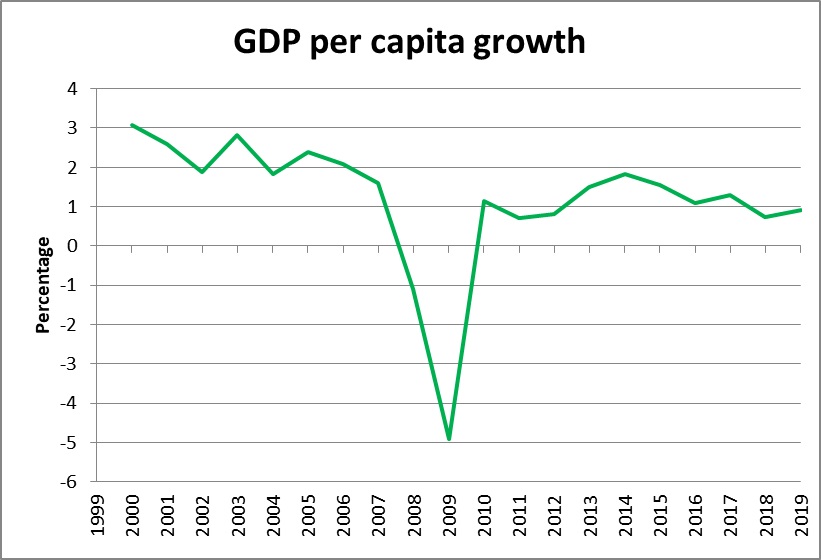
Let’s start off with an examination of the facts as presented in the form of the following two graphs.

The first of these graphs shows our overseas trading account (also known as our current account or “BoP” = “balance of payments”) over the past twenty years split between the EU and the rest of the world (I have shown the US and China separately for general interest but they are not needed for this argument and pretty much cancel each other out anyway). The point that should immediately spring out is the divergence between our plummeting trade with the EU and the strength of trade with the rest of the world, which has moved firmly into surplus.
What on earth could have caused this? The exact causes probably comprise thousands of different but distinct factors, but one thing that is clear is that the EU is the only differentiating factor between them, as all other factors are common to both. Or to put it more bluntly, for all that time Brussels has been surreptitiously and progressively blocking our exports using ever higher non-tariff barriers. Or even more bluntly, the thieving bastards have been stealing from us! One can only speculate about why they would do such a thing, but I suspect ‘punishment’ of us for not joining the euro features prominently. Even worse, our dozy officials in Whitehall have either not even noticed, or if they have they have connived in the fraud.
The next question is to what extent does this matter. And the answer is a lot. The numbers are huge. The annual losses are now roughly ten times the Brexit dividend from no longer paying into the EU budget, and a plummeting deficit means people are buying more and more foreign stuff and less and less British stuff, which means that jobs are being lost left right and centre. Not only that but business will not invest into a contracting market. They normally need an expanding market to absorb the increased production which in turn carries the new technology and greater efficiency that creates economic growth and makes us all better off. This is confirmed by the second graph which shows our economic growth rate over the same period falling from 2.8% in 1999 to 0.7% in 2019.
Predictably Remainers will try to counter this by blaming the banking crisis, and the second graph shows this as a great big downward spike in the middle. But look at how that spike bounces straight back up again a year later and then continues along its previous trend line as though nothing has happened. That proves that the banking crisis actually had only a very temporary effect on the economy.
Then they will say that the amount of money printing (“quantitative easing”) required to recapitalise the banks continued to grow to a peak of £425bn by 2016. But in fact less than £100bn actually went to the banks. So guess what the rest was needed for? Yes, to replace all the jobs lost to the EU trade deficit! The cost of replacing these jobs is the reason why we now have record levels of national debt and record levels of personal debt, produced by intensive fiscal and monetary stimulus, but this is not a sustainable situation.
So how do we get out of this mess? We can’t stop the EU from piling on export barriers against us but we can use tariff barriers against them if we tear up the agreement. Furthermore without a deal we will regain the protection of the WTO’s most favoured nation rule which prohibits members from applying different tariffs and standards to different countries. ‘Free traders’ will object and call it protectionism, but tariffs are really the only instrument we have to manage the situation. Imposing tariffs on a deficit will produce gains from import substitution that more than offset any loss on exports. And if people complain about the increase in import prices on EU goods just tell them to buy British, or indeed from the rest of the world at no extra cost.
Big Business will (as I suspect they have been from the outset, directing their poodle the Tory party behind the scenes) object to their EU customers having to pay the full EU tariffs which indeed they will when we have ripped up the deal. But here is the clever bit. We can offset the tariffs. That is we can use the new import tariff revenues to pay directly the EU’s tariffs on our exports so that our export customers do not have to pay them. That will give the Treasury a positive cash flow because of the deficit and conversely is not an option open to the EU. And it is entirely legal under WTO rules.
This lack of imagination is probably why the Tories thought they had to do some sort of deal with the EU, whereas other Brexiteers have always argued for a No Deal. Why do a deal when there is nothing you want from the other side?
People come to Brexit from a whole range of different angles, but I hope I have demonstrated here that recovering our sovereignty over our economy must surely be amongst the most pressing of all the issues we face.






I always get irritated when people refer to the BOP total for just a few years. We have been in the EEC/EU for nearly 50 years and we must look at this as a fifty year experience. If one goes back to 1973 when we joined the EEC (thanks to the treacherous Conservative Party) we had a virtually zero BOP with the EEC. Since then thanks to EEC/EU policies the UK has built up a BOP DEFICIT costing us well over £2 TRILLION in todays money. Indeed, Angela Merkel moaned that outside the EU the UK would be a “competitor” In other words “inside” the EU the UK would NOT be a competitor as they could twist us round their little fingers. (Witness Major, Blair, May et al.) Over that period of time we have also given our competitors in the EU nett budgetary contributions costing us over £300 billion in todays money. A significant figure in comparison to our nation debt of over £2 trillion. Remember that most of the EU’s members are net beneficiaries of UK taxpayers money! There were many other downsides to being in the EU Not least of which was the 30 trillion euro cost of their pay as you go pensions for the next generation .As the second highest contributor to EU funds the UK would most certainly have had to support that cost!
Hi Jeremy, I don’t disagree with anything you say; just to explain that the past twenty years provide a good demonstration of how a divergence has developed compared to our success in the rest of the world. I suggest it is that that highlights the deliberate nature of their export blocking policy against us.
Whomsoever designed the puzzle picture, missed something. A huge elastic band to the white space, ‘where we belong'(?).
I’m really upset that I do not understand the article or the graphs. What exactly is BoP, Balance of Payments?
I understand that for many years we have imported far more from EU than we exported to them.
That meant that our trade suffered by being in the EU, because exporting to the rest of the world suffered from EU tariffs and other problems.
I also understand that somehow EU managed to ‘asset strip’ many of our industries. Not sure how but I think it was to do with their regulations. Also, of course we always paid far more to the EU than they ever gave back to us.
So far as I was concerned, throughout the transition year I was convinced that we should have walked away, No Deal. We should have gone to trading WTO for those reasons and because of the so called ‘divorce bill’.
I agree with you Pauline. Economics was never a strong point with me. But I always hated the EU. It was always obvious that they hated us too! We represented the ‘old enemy’ to the Germans and the French. I firmly believe the the EU is in cahoots with our Remainer Civil Serpents and politicians to either break us financially or get us back in so they can keep sucking us dry!
Me too. But many thanks to John Poynton for the article.
tHE OTHER BIG PROBLEM UP THERE WITHT TAXES. IS actually the same problem.
BUREAUCRACY (The cost of bureaucracy is most of the country ) Everbody uses a computer and is lost.. Those using computers provide us with facile and usually incorrect and piffling guesses, and sales ‘ come ons ‘
I estimate that 93%of all British Firms Died between 1965 and 1990 from buying a half million oversol piecce of crap.That was never ever capable of doing anything much but was sold as the answer to everything and amust have Directore status symbol.
IBM. May their salesmen rot in hell American salesmen still are and probabley always will be dangerous. They take as much money as they can and tie customers up into horrific dreams. I Never actually met one of these machines that worked any better tham a punched card machine. How Turing managed I have no idea. Unless he had an english one. But watching the film it rather reminded me of an old Hollerith.Long live Consumerism the American destructive malignant dream.
Spot on..
Every day we pile on more taxes ( that’ s all that tarifs are ) and it’ll keep getting worse until the huge basket of ( Our70 plus ) of taxes, wasted by politics, s.tops.
The Labour party never reduces these onl increases. It’s their only selling point :- Poverty.
Mrs May with the politicians managed to disguise the disastrous economy by inventing new useless industries like HR.,Uman rights, Elf and Safety.,and all the other ridiculous ee. measures